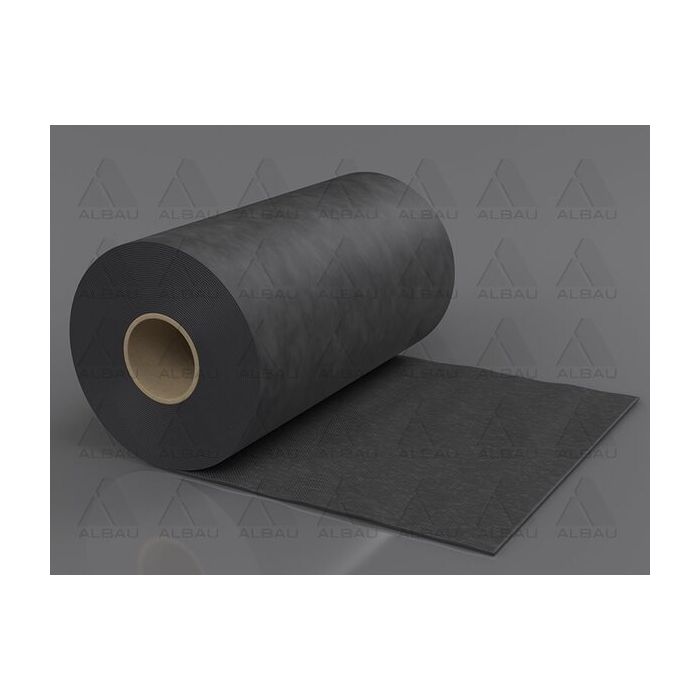
Suitable For: Cavity wall construction Material: EVA (ethylene vinyl acetate terpolymer) Roll Length: 25 m Thickness: 1,2 mm Root Resistance: acc. to DIN 4062 Temperature Resistance: -50°C to +80°C Color: Anthracite / Grey
* Triple-layer, 1,2 mm thick DIN-compliant and bitumen-compatible damp proof course – elastic and watertight. It meets the requirements of DIN EN 14909, DIN V 20.000-202 and DIN 18533
* The double-sided non-woven fabric enables an excellent connection to the masonry mortar, thereby ensuring high shear strength in the masonry
* The membrane boasts extreme tear strength – longitudinal > 600 N / 5 cm to transverse > 450 N / 5 cm.
* only half as heavy at the same thickness as other commercially available 1,2 mm PVC damp proof courses
* Resistant to rising moisture and rot-proof, securely protecting the masonry from the ground up
* Used as a horizontal barrier layer installed in the lowest horizontal joint of the masonry between two mortar layers and can also be used as an L- or Z-barrier in a cavity wall. It can also be used in the area of wall openings, such as window openings, lintels or balustrades
* Easy and efficient to install and is easy to cut from the 25 m long roll
* UV-stabilised and retains its flexibility at all temperatures
* Can be glued with elastic glue for waterproofing membrane (ALB-GLUE-WM/310)
**Installation:**
* The waterproofing EVA membrane is laid in one layer.
* The surface must be levelled out using Group 2 or 3 mortar acc. to DIN 1053 in order to obtain an even surface
* Then fit the membrane into the horizontal joint between two mortar layers on the base slab
* At the joints, a sufficient overlap of 20 cm must be ensured
* The width of the damp proof course must be selected so that no moisture bridges can form to the side of the bricked-up wall
* As an L-barrier in a cavity wall, the membrane is glued to the rising masonry with elastic glue
* As a Z-barrier in a cavity wall, the membrane is fit into the shell masonry, then later inserted into the facing shell
Keep your delivery details ready for your next order.
Orders in one place
Follow your orders and find your purchase history.
For you and your business
Create a personal or company account for your projects.
XBAU
Your account. Your next project.
Faster checkout
Keep your delivery details ready for your next order.
Orders in one place
Follow your orders and find your purchase history.
For you and your business
Create a personal or company account for your projects.
Your privacy choices
We use essential cookies to keep Xbau working. With your permission, analytics and marketing cookies help us improve the site and measure advertising.
Privacy policy
Cookie settings
Choose which cookies Xbau may use. You can change your choice at any time.
Cookie Policy
Essential cookies
Required for core site functions, security and checkout.